
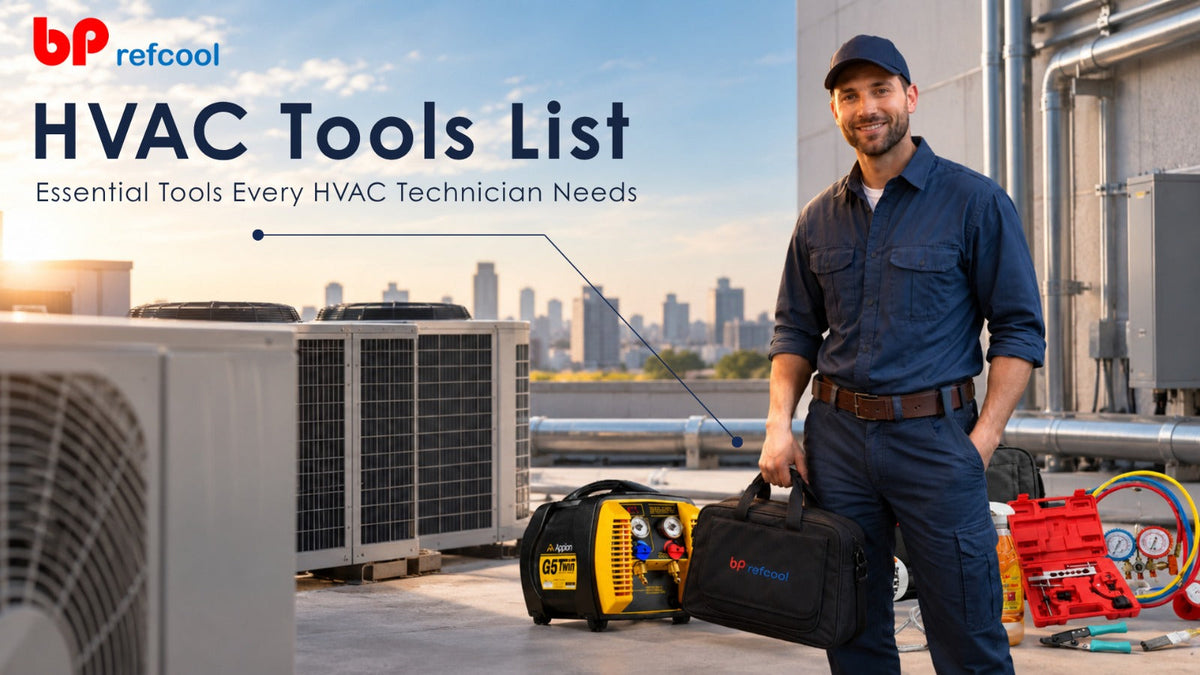
Whether it's installing a new system, tracing a refrigerant leak, or doing routine maintenance, the quality of HVAC work depends heavily on the tools in the truck. The right equipment saves time, improves accuracy, and helps technicians deliver repairs that last. This guide walks through the essential HVAC tools every technician should know, what each one does, and why it matters.
1. Manifold Gauge Set
If there is one tool that defines HVAC service work, it's the manifold gauge set. It measures the high-side and low-side refrigerant pressures of a system, giving you a quick picture of how it is performing. Pressures alone don't tell the whole story, but combined with temperature readings, they let you calculate superheat and subcooling, the key numbers that show whether a system is properly charged.
Many technicians now use digital manifolds, which add temperature probes, built-in pressure-temperature charts, and automatic superheat and subcooling calculations. Whether analogue or digital, this is usually the first tool out of the bag on any refrigeration or air conditioning call.
2. Vacuum Pump and Micron Gauge
Before refrigerant goes into a system, air and moisture must come out. Both cause serious problems: moisture can form acids and damage compressor oil, while non-condensable gases raise head pressure and reduce efficiency. A vacuum pump pulls the system down to a deep vacuum, a process called evacuation.
To confirm the job is done properly, technicians use a digital vacuum (micron) gauge. A manifold gauge can't read vacuum levels accurately enough, but a micron gauge shows exactly how deep the vacuum is and whether it holds. A system that rises quickly after the vacuum pump is isolated usually has a leak or leftover moisture. Skipping proper evacuation causes failures that often show up months later, so this pair is one of the most important investments a technician can make.
3. Refrigerant Recovery Machine
When a repair requires opening the refrigerant circuit, the refrigerant must be removed safely. A recovery machine transfers it from the system into an approved recovery cylinder. Releasing refrigerant into the atmosphere is harmful to the environment and illegal in most regions, so recovery is not optional.
In many countries, technicians must also be certified to handle refrigerants. In the United States, for example, this means EPA Section 608 certification. Always check the rules that apply where you work.
4. Refrigerant Leak Detector
Refrigerant leaks cause poor cooling, higher energy bills, and repeated service calls. Electronic leak detectors can find even small leaks quickly by sensing refrigerant in the air near a joint, coil, or fitting. Compared with trial and error, a good detector cuts troubleshooting time and helps ensure the leak is truly fixed before the system is recharged.
Bubble solution and UV dye are useful backups for confirming a suspected leak, especially in hard-to-reach spots.
5. Charging Scale
Adding too much or too little refrigerant hurts efficiency, strains the compressor, and can shorten equipment life. Many systems are charged by weight, and a digital charging scale lets you add exactly the amount the manufacturer specifies. It's a simple tool, but precision here protects both the equipment and your reputation.
6. Temperature Measurement Tools
Accurate temperature readings are just as important as pressure readings. Clamp-on thermometers and pipe probes measure line temperature, which is needed to work out superheat and subcooling. A good thermometer also helps check supply and return air temperatures, so you can see how much a system is actually cooling the air.
7. Electrical Testing Tools
A large share of HVAC problems are electrical. Three tools cover most situations:
-
Digital multimeter for voltage, resistance, continuity, and capacitance checks.
-
Clamp metre for measuring current draw on compressors and motors without breaking the circuit.
-
Non-contact voltage tester for a fast safety check before touching any wiring.
Together, these help diagnose failing capacitors, contactors, relays, motors, and control boards. Always confirm power is off before working on any component.
8. Tubing Tools: Cutters, Flaring, and Swaging
Working with copper tubing means making clean, accurate connections. Tubing cutters produce square, burr-free cuts. Ecoab Flaring tools create secure flare connections, common on many split systems. Swaging tools expand the end of a tube so another piece can slide inside it for brazing. Good tubing tools lead to better connections and fewer leaks.
9. Coil Cleaning Tools
Dirty condenser and evaporator coils reduce heat transfer, increase energy use, and put an extra load on the compressor. Coil brushes, fin combs, sprayers, and approved coil cleaners restore airflow and efficiency. Regular coil cleaning is one of the simplest and most effective maintenance tasks, and it's a service customers can easily see the benefit of.
So, Which Tool matters Most?
If you had to pick just one, the manifold gauge set is hard to beat. Almost every diagnosis starts with pressures and temperatures, and the other tools either confirm what the gauges show or help fix what they reveal. A close second is the vacuum pump paired with a micron gauge, because a poor evacuation creates problems that appear long after the technician has left.
That said, great HVAC service isn't only about tools. It's about knowing how to use them correctly, understanding what the readings mean, and following safe, legal practices. The best results come from combining quality equipment with proper training and experience.