
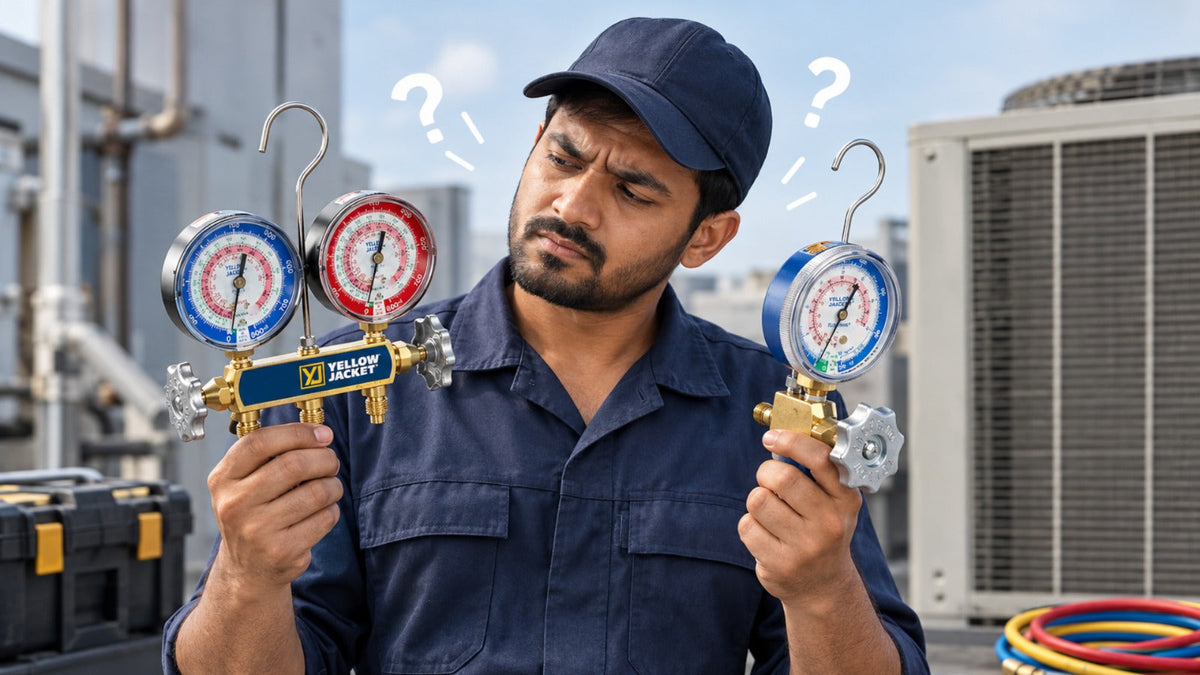
How to Choose the Right HVAC Manifold Gauge Set
Choosing the right HVAC manifold gauge set is an important decision for air conditioning technicians, refrigeration engineers, and automotive A/C service professionals. The right tool helps measure refrigerant pressure, evaluate operating conditions, and carry out maintenance procedures according to equipment requirements.
With different gauge types, refrigerant compatibility requirements, pressure ranges, hose configurations, and digital features available, finding a suitable option can be challenging. Technicians searching for the best HVAC gauges should consider more than price or brand reputation. The tool must match the equipment, refrigerant, and service procedures involved.
Whether you work with residential air conditioners, commercial refrigeration systems, or automotive air conditioning, understanding the essential features of a manifold gauge set can help you make a more informed purchasing decision.
What Is an HVAC Manifold Gauge Set?
An HVAC manifold gauge set is a service tool used to measure refrigerant pressure in air conditioning and refrigeration systems. A typical set includes pressure gauges, a manifold body with valves, and service hoses that connect to the relevant system ports.
Traditional manifold gauge sets use two gauges:
-
Low-pressure gauge: Commonly identified by a blue dial or connection, it measures pressure on the low-pressure side of the system.
-
High-pressure gauge: Commonly identified by a red dial or connection, it measures pressure on the high-pressure side.
The manifold valves control refrigerant flow during compatible servicing procedures. Depending on the design, additional ports or valves may support specific maintenance operations.
Technicians use pressure readings to assess system operating conditions and identify situations that require further investigation. However, pressure readings alone do not confirm the cause of every refrigeration problem. Temperature measurements, manufacturer specifications, airflow checks, and other diagnostic procedures may also be necessary.
Types of HVAC Manifold Gauge Sets
Understanding the available gauge configurations makes it easier to select a tool for your daily service requirements.
1. Analogue Manifold Gauge Sets
Analogue gauges display pressure through a needle and graduated dial. They are familiar to many technicians and do not require batteries to display pressure readings.
These gauges can be suitable for routine HVAC and refrigeration maintenance when their measurement range, accuracy, and refrigerant compatibility match the application.
Before purchasing an analogue set, check the dial markings, scale readability, stated accuracy, and availability of replacement gauges. Clear graduations are particularly useful when readings need to be interpreted quickly in different working conditions.
2. Digital Manifold Gauge Sets
Digital manifold gauges use electronic displays to present pressure readings. Depending on the model, they may also provide temperature measurements, refrigerant-specific pressure-temperature information, data recording, and additional diagnostic functions.
For example, YELLOW JACKET's ManTooth Digital Manifold combines digital gauges with a two-valve brass manifold. Its manufacturer lists support for multiple refrigerants, including R-1234yf, along with a backlit display and electronic pressure measurements. Available features and specifications should always be checked against the exact model. Source: YELLOW JACKET ManTooth Digital Manifold
Digital models can be useful for technicians who need additional measurements or calculations during servicing. However, not every digital manifold includes the same features, so buyers should compare specifications rather than assume all models offer equivalent functionality.
3. Two-Valve and Four-Valve Configurations
Two-valve manifold sets are commonly used for service tasks involving low- and high-pressure connections.
Four-valve configurations provide additional flow-control options and may be useful for particular evacuation, charging, or servicing procedures when the equipment supports them.
A more complex configuration is not automatically better. Choose the valve arrangement according to the procedures you perform regularly and the connections required by your equipment.
Key Factors to Consider Before Buying an HVAC Manifold Gauge Set
1. Check Refrigerant Compatibility
Refrigerant compatibility should be one of the first things to verify. Different refrigerants have different pressure-temperature relationships and operating requirements. A manifold gauge set must have a suitable measurement range, compatible materials, and appropriate connections for the intended refrigerant.
For example, equipment intended for older refrigerants may not be suitable for every modern refrigerant application. Systems using R-410A, R-32, or R-1234yf require tools selected according to their specific service requirements.
R-1234yf is particularly relevant to automotive air conditioning. Technicians servicing these systems should look for an R1234yf manifold gauge set designed for the refrigerant and vehicle connections involved. Dedicated options may include specific high- and low-side couplers and compatible hoses.
YELLOW JACKET, for example, offers charging manifolds and hoses designed specifically for R-1234yf automotive A/C applications. This illustrates why buyers should check the intended application instead of assuming that a general-purpose HVAC manifold will suit every system. YELLOW JACKET R-1234yf Charging Manifolds and Hoses
Always verify refrigerant compatibility, pressure ratings, connection specifications, and the manufacturer's instructions before use.
2. Evaluate the Pressure Measurement Range
The pressure range determines which readings a gauge can display. If the range does not suit the system, the instrument may not provide the information needed for the intended service task.
Check the low- and high-pressure measurement ranges against the equipment manufacturer's service requirements. Avoid choosing a gauge solely because it has a large maximum pressure rating. Readability and suitability for the actual application are equally important.
The manifold body, hoses, fittings, and connected accessories must also be rated for the pressures involved. A suitable gauge does not make an incompatible hose or fitting safe to use.
3. Consider Measurement Accuracy and Readability
Reliable readings help technicians assess system conditions more effectively. When comparing products, review the manufacturer's stated accuracy, dial graduations, display resolution, and available temperature scales.
For analogue models, clearly marked dials make pressure readings easier to interpret. For digital models, examine the specified accuracy, display quality, battery requirements, and measurement functions.
Digital displays may also show refrigerant-specific pressure-temperature information when the relevant refrigerant is supported. These functions can help technicians interpret measurements, but they do not replace proper diagnostic procedures.
Gauges should be inspected and maintained according to the manufacturer's recommendations. Damaged, leaking, or unreliable instruments should not be used for service work until appropriately assessed.
4. Check Hose Quality and Connection Fittings
Service hoses connect the manifold to the relevant system ports. Their pressure ratings, length, flexibility, temperature limits, and connection types affect practical usability.
Shorter hoses may be convenient in compact service areas, while longer hoses can provide additional reach when working around larger equipment. The appropriate length depends on the service environment and equipment layout.
Check fitting sizes, refrigerant compatibility, sealing condition, and the manufacturer's working-pressure and burst-pressure ratings. Some automotive systems use connection arrangements that differ from those found on conventional HVAC equipment.
Before buying, confirm whether the set includes the required hoses, adapters, and couplers or whether these must be purchased separately.
5. Look at Build Quality and Ease of Use
A manifold gauge set is frequently transported between service locations and used in demanding working environments. A durable manifold body, legible gauges, reliable valves, and well-made connections can support regular professional use.
Also consider the weight of the set, control accessibility, hose arrangement, and whether a storage case is included. Easy-to-operate valves and clearly identified connections can make routine servicing more convenient.
Check the warranty terms and availability of replacement gauges, seals, hoses, and other serviceable components. These details may influence long-term ownership costs.
Analogue vs Digital: Which Manifold Gauge Is Better?
The choice between analogue and digital gauges depends on your workflow, budget, and measurement requirements.
Analogue gauges can be a practical option for technicians who prefer familiar dial displays and straightforward operation. They can handle routine service tasks when their specifications match the system and the instruments are properly maintained.
Digital gauges may be preferable when electronic displays, additional measurements, or refrigerant-specific calculations are useful. Some models offer backlit screens and support multiple refrigerants, making them worth considering for technicians who work across different applications.
For buyers researching YELLOW JACKET digital manifold gauges, the manufacturer's ManTooth Digital Manifold is one model to examine. Its published specifications include support for R-1234yf and several other refrigerants. The listed pressure range, accuracy, hose ratings, and other details should be checked against the current product documentation before purchase.
Neither analogue nor digital gauges are automatically the best choice for every technician. Compare the supported refrigerants, measurement accuracy, pressure range, included accessories, and features you will actually use.
Common Mistakes to Avoid When Buying a Manifold Gauge Set
Avoid these common mistakes when comparing manifold gauge sets:
-
Ignoring refrigerant compatibility: Confirm that the set is suitable for the refrigerant and application.
-
Overlooking pressure ratings: Check the ratings of the manifold, hoses, fittings, and connected accessories.
-
Choosing the wrong measurement range: Ensure the gauges cover the pressure requirements of the intended system.
-
Assuming all digital gauges offer the same functions: Verify the specifications of the exact model.
-
Ignoring connection requirements: Confirm the correct fittings and couplers are available.
-
Focusing only on price: Compare accuracy, durability, warranty, and replacement-part availability.
-
Buying unnecessary features: Choose a configuration that supports your actual service tasks.
-
Neglecting inspection: Check hoses, seals, valves, and gauges for damage or wear before use.
A careful comparison helps reduce compatibility problems and avoidable equipment replacement.
How to Choose the Right HVAC Manifold Gauge Set for Your Needs
Start by identifying the equipment you service most frequently.
If you primarily work on residential air conditioners, select a manifold gauge set compatible with the relevant refrigerants, system pressures, and service connections. Technicians working with commercial refrigeration or multiple HVAC systems may need broader refrigerant support and additional connection options.
For automotive air conditioning, confirm whether your work involves R-1234yf, R-134a, or both. An R1234yf manifold gauge set should be evaluated for its refrigerant compatibility, coupler design, hose specifications, and intended vehicle applications. Do not assume that a set designed for one refrigerant is automatically suitable for another.
Next, decide whether analogue readings meet your needs or whether digital functions would be useful. Compare the measurement range, stated accuracy, hose ratings, fittings, warranty, and included accessories across suitable models.
Finally, review the product documentation and confirm that every component meets the requirements of the intended application. If you service multiple refrigerants, verify compatibility separately for each one.
The best HVAC gauges are those that meet your actual service requirements, provide suitable measurements, and are compatible with the equipment you maintain.
Frequently Asked Questions
1. What is an HVAC manifold gauge set used for?
An HVAC manifold gauge set measures refrigerant pressure during air conditioning and refrigeration servicing. Technicians use these readings alongside other measurements to assess operating conditions and investigate potential system issues.
2. What is the difference between analogue and digital manifold gauges?
Analogue gauges display pressure using a needle and dial, while digital gauges show electronic readings. Depending on the model, digital sets may also provide temperature measurements, refrigerant-specific calculations, or data-recording functions.
3. How do I choose an R1234yf manifold gauge set?
Check that the set is designed for R-1234yf applications and that its pressure ratings, hoses, fittings, and couplers meet the relevant service requirements. For automotive A/C work, confirm compatibility with the vehicle's service connections and follow the equipment manufacturer's instructions.
4. Are YELLOW JACKET digital manifold gauges suitable for multiple refrigerants?
Some models support multiple refrigerants. For example, YELLOW JACKET's ManTooth Digital Manifold lists R-1234yf among its supported refrigerants. Always consult the current specifications for the exact model to confirm its supported refrigerants and pressure ratings.
5. How often should manifold gauges be inspected?
Inspect gauges, hoses, seals, valves, and fittings before use. Follow the manufacturer's recommendations for accuracy checks, calibration where applicable, and maintenance. Remove damaged or leaking equipment from service until it has been properly assessed.
v